Self storage SEO is the work of getting your facilities found when someone nearby searches for storage, in Google's results, on Google Maps and, more and more, in AI answers. It matters more for storage than for most businesses, because renters rarely know a brand before they search. They search for storage near a place, compare a few results, and rent from one of them.
This guide covers how storage renters search, the pages and profiles that rank, the technical basics, AI search, and how to measure whether any of it is producing rentals.
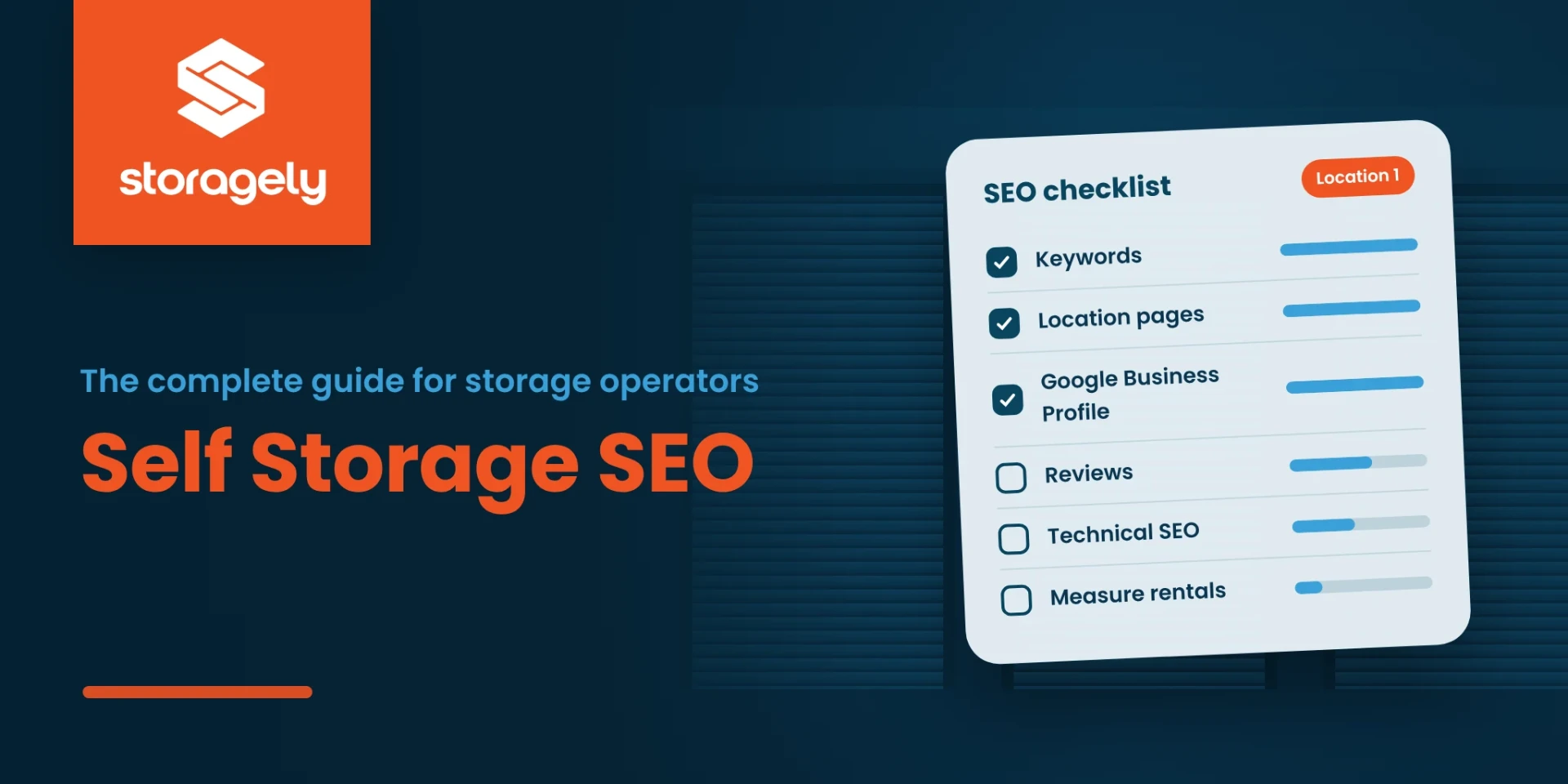
Work through the self storage SEO checklist one location at a time.
How storage renters search
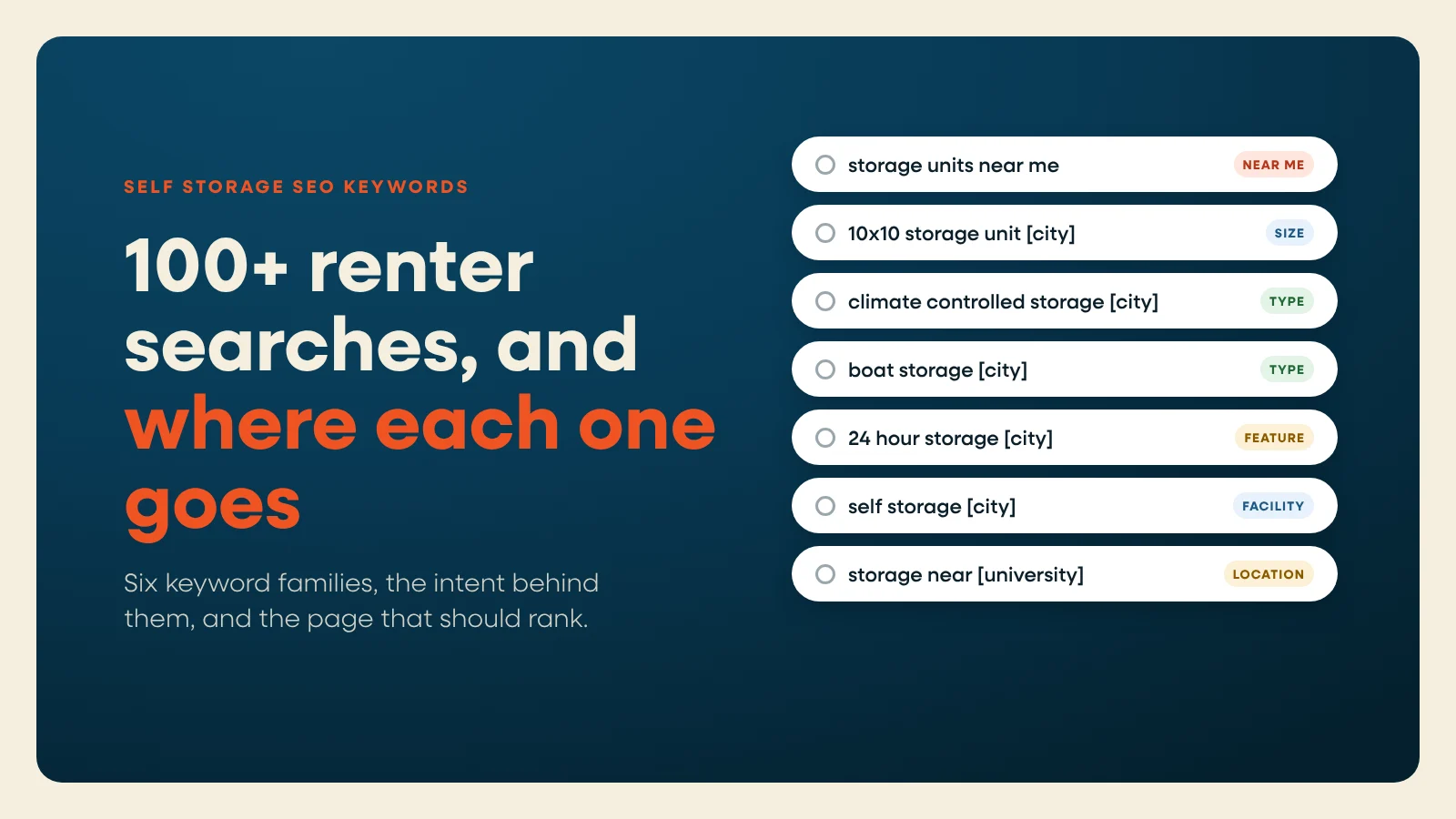
Almost every storage search is local. People search "storage units near me", "self storage in [town]" or "storage near [neighborhood]", often adding a unit type ("climate controlled", "RV storage", "drive up") or a price signal ("cheap", "first month free").
Google answers those searches in two places:
- The local pack and Maps: the map with three businesses under it, plus Google Maps itself. This ranking is driven by your Google Business Profile, how close the searcher is, and your reviews.
- The organic results below it: driven by your website's pages.
You need both. A facility can rank well on Maps and still lose the renter on a weak website, or have a strong website that never shows on the map.
Choose the right keywords
Start with the searches already reaching you, in Google Search Console, and with what your office hears every day. Then map each kind of search to one page: location searches to the location page, unit-type searches to storage-type pages, size questions to the size guide.
Read the full guide to choosing self storage keywords.
Location and storage-type pages
One facility can match many searches: "storage in [town]", "climate controlled storage [town]", "boat storage near [lake]". One generic page can't rank for all of them. The pages that do the work:
- One page per facility, with the name, address and phone number exactly as they appear on your Google Business Profile, plus hours, gate hours, amenities, photos, reviews and live units with prices.
- Storage-type pages for what each facility actually offers: climate-controlled, drive-up, vehicle, RV, boat, business.
- City and area pages for operators with several facilities in a market, linking to each location.
Each page needs real, specific content: what's there, how to get there, what it costs. A page with the town name swapped into the same paragraph won't rank for long.
See what the best self storage websites include.
Google Business Profile and Maps
Your Google Business Profile is often the first thing a renter sees. Get the basics right for every location:
- the correct primary category ("Self-storage facility"), plus accurate secondary categories;
- the exact business name, address and phone number, matching your location page;
- office hours and gate hours;
- recent photos of the facility, the office and the units;
- a link to that location's page, not just your homepage;
- a booking action, so renters can reserve or rent straight from the listing.
Read the local self storage marketing guide, and how to improve your facility's visibility on Google Maps.
Reviews
Reviews affect where you rank on Maps and whether a renter picks you. Ask every new tenant for one, at a moment when they're happy (for example, right after move-in), and reply to every review, good or bad, within a few days. A calm, specific reply to a bad review often does more for the next renter than the review itself does harm.
Show your reviews on your location pages too, so renters see them on your site, not just on Google.
Technical SEO for storage websites
Technical problems stop good pages from ranking. Check these at least once a quarter:
- Indexing: every location and storage-type page can be indexed (no stray "noindex"), returns a 200 status, and is in your sitemap. Pages that have moved redirect in one step with a 301.
- One URL per page: a canonical tag on every page, no duplicate versions with and without "www" or a trailing slash.
- Speed and mobile: pages load fast on a phone, and the unit grid and rent button work without zooming.
- Structured data: schema markup for the business, the facility, its units, FAQs and reviews, so search engines understand each page.
- Headings: exactly one H1 per page, saying what the page is about.
- Broken links: none, in navigation or in posts.
Use the step-by-step self storage SEO checklist, and see the tools that help.
Content that earns rankings
Beyond location pages, helpful content brings in renters earlier on: size guides, "what fits in a 10x10", how to prepare items for storage, vehicle storage requirements, local moving guides. Write for the renter's question, not for a keyword count, and link each article to the location or storage-type pages it relates to.
Consistency beats bursts. A few useful pages a month, kept up to date, do more than a large batch published once and left alone.
SEO for AI search
More renters now get answers from Google's AI Overviews and AI assistants. Those answers draw on pages that state facts clearly. To be the page they cite:
- put the essentials (address, hours, unit types, sizes and prices) in plain text on each location page;
- answer common questions directly, in FAQ sections with matching schema;
- keep your business details identical across your site, your Google Business Profile and directories;
- keep earning reviews.
Read the guide to SEO for AI search.
SEO or Google Ads?
They do different jobs. Google Ads puts you at the top of the page today, for as long as you pay. SEO takes months to build, but it keeps working without a cost per click. Most operators use both: ads to fill units in competitive or new markets, and SEO for the steady base of local searches. Either way, track which source each rental came from.
Compare Google Ads and SEO for self storage.
Measuring self storage SEO
Rankings are a means, not the result. Track:
- In Search Console: impressions, clicks and average position for each location and storage-type page, and any indexing errors.
- On Google Business Profile: calls, direction requests and website clicks for each location.
- On your website: online rentals and reservations by page and by source, so you know which searches turn into move-ins.
Check monthly, and judge changes over three months or more, not week to week.
Doing it yourself or hiring help
A single-location operator with time and a good website platform can handle most of this in-house: the profile, reviews, location page and a few useful articles. It gets harder with several locations, competitive markets, or a website that fights you on technical basics.
If you hire, look for a provider who explains the work in plain terms, reports on rentals and not just rankings, and never promises a position on Google. Storagely builds the technical and local SEO into its websites, and offers hands-on help through self storage SEO services. For budgeting, see how to budget for SEO services.
FAQ
What is self storage SEO?
The work of getting storage facilities found in Google search, Google Maps and AI answers, through location and storage-type pages, Google Business Profile, reviews, technical health and helpful content.
How long does self storage SEO take to work?
Technical fixes count as soon as Google recrawls your pages, but rankings usually move over months. Competitive markets and new websites take longer.
What matters most for ranking a storage facility on Google Maps?
A complete, accurate Google Business Profile with the right category, how close the searcher is, and the number and quality of your reviews. A strong location page that matches your profile helps too.
Do I need a separate page for each location?
Yes. Each facility needs its own page with its own address, hours, photos, reviews and units, linked from its Google Business Profile.
Is SEO better than Google Ads for self storage?
Neither is better on its own. Ads bring visibility right away while you pay, and SEO builds lasting visibility over time. Most operators use both and track which one produced each rental.
Related reading
See where your location stands in search
Get a free Scorecard for one location: search visibility with a local geo-grid, reviews, rental friction and website health.