Why “Free” or “Included” Online Storage Websites Cost Operators Revenue
· Storagely · 9 min read · Updated
Learn how “free” or “included” online storage websites could be costing you money and hurting self storage rentals and ROI over time., Importance of SEO for Self Storage Facilities In today's digital age, having a strong online presence is essential for any business, includi
Everyone loves free offers. Free samples. Free trials. Free tote bags that lie around your house for decades. So, when your storage FMS (Facility Management Software) offers a “free” or discounted website bundled into your package, it can feel like a win.
However, “free” or “included” online storage websites can feel like free Wi-Fi with a 2-bar signal. You’re connected, but you’re expecting connectivity issues.
Yes, you may get an online platform that syncs well with your FMS, but many of these sites will act more like an online brochure than a functional, conversion-first self storage website. A website that looked like a bargain could cost you precious revenue in the long run. In an industry where a small increase in conversion rates can translate to thousands in annual revenue, this is no small trade off.
Today, it’s more important than ever for storage operators to invest in websites that actively convert leads, increase revenue, and outshine competitors. The good news? With website platforms like Storagely, you get the best of both worlds: a site that seamlessly integrates with your FMS and delivers a flawless digital experience that converts.
How can these convenient FMS websites affect your bottom line? Let’s take a closer look.
Things to Avoid With a Bargain Storage Website
- Confusing navigation
- It takes too many clicks to rent
- Limited pricing display options
- No mobile-first design
- Checkout takes too long
- Redirects to third-party sites for payment
- No AI integration
- No interactive tools
- Lacking SEO

Navigation: Every Step Should Guide Potential Tenants to Rent
A visitor will judge your website within .05 seconds,1 giving you an incredibly small amount of time to make a positive impression and keep them from bouncing to a competitor. When a potential tenant visits your storage website, they’re not looking for a scavenger hunt. Every tab, link, and web page should work together as one to achieve a single objective: rentals.
However, many “free” or “included” websites make visitors click through multiple pages before they can find the rental page. Sometimes the facility map sends users to an external map platform instead of a location page, or the “Facilities” tab doesn’t clearly list facilities. These details aren’t trivial. The smallest point of confusion can make or break a rental.
Renters are usually looking for three things on a storage facility website:
- Unit Availability
- Pricing
- A Clear Path to Rent
According to a Clutch survey, 94% of respondents chose easy navigation as the most useful website feature.2 If a visitor has to hunt for the “Rent Now” button, they may simply hunt for another facility instead. Clear navigation isn’t just about aesthetics; it builds confidence. When leads can quickly see available units, features, and pricing, they feel in control.
Friction is anything that makes a renter pause. An extra click, a confusing label, a slow-loading page, or a broken link can cause a lead to rethink their decision. Each tiny hesitation introduces doubt: Is this worth it? Is there an easier option?
For online storage websites, “easier” usually wins. Reducing friction is the best way to increase conversions and, therefore, revenue.
Reducing Friction Means:
- Fewer clicks between the landing page and checkout.
- Clear, consistent calls-to-action on every page.
- Pricing displayed upfront (no guesswork required).
- Clearly listed features that showcase value.
- Facility pages that lead directly to live availability.
- Navigation labels that say exactly what they mean.
The importance of a simple, straightforward self storage website design cannot be understated. When in doubt, all roads should lead to the rental page.
This is where specialized expertise becomes a competitive advantage. A self storage website crafted by a team that understands the nuances of website design and the storage rental process isn’t just visually appealing; it’s strategically engineered. Every page, feature, and call to action is intentionally created to reduce friction, highlight value, and guide renters seamlessly through the process.
Designing for self storage isn’t the same as a generic business website. It requires an understanding of unit sizes, pricing strategy, promotions, tenant behavior, abandoned rentals, and mobile-first leasing. When your website and rental system are developed by experts who live and breathe the storage industry, you benefit from a platform that actually performs.
Ensure Your Website Is Mobile-First for the Modern Renter
Here’s a fact that shouldn’t surprise anyone: most storage searches happen on mobile devices. In fact, 62.54% of global website traffic now comes from mobile,4 and mobile commerce is projected to account for 59% of total retail sales in 2025.6
Is your website mobile-friendly? If your storage website looks great on a desktop but feels awkward on a phone, you’re essentially putting up a “Closed” sign for a large portion of potential renters.
Some FMS websites still feel like they were built for desktop first, with mobile responsiveness added later as an afterthought. If buttons are too small or checkout is clunky, the entire mobile experience can feel cramped and frustrating.
A mobile-first website is not about shrinking content to fit a smaller screen. It is about designing for thumbs, speed, and simplicity. Considering that 53% of users abandon a site that takes longer than three seconds to load, even a one-second improvement in load time can increase conversions by 27%, according to a Liquid Web study.3 Performance directly impacts self storage rentals.
On mobile, your storage facility website should:
- Load in under three seconds.
- Display real-time pricing and unit availability clearly.
- Feature large, thumb-friendly buttons.
- Keep the primary call to action visible at all times.
- Allow customers to complete the entire rental process without switching devices.
If someone can order dinner, book a ride, and refinance a mortgage from their phone, they should absolutely be able to rent a 10×10 storage unit just as easily.
Your Self Storage Checkout Should Facilitate Tenant Trust
With the right rental system, your online checkout experience can be your number one lead converter. However, many FMS websites rely on clunky, multi-page checkouts that require a large amount of information up front.
Once renters write a short novella in order to rent a unit, they may be redirected to a third-party payment page that looks different from the main site. That sudden shift can feel jarring and shady at best when you’re handing over credit card information. When potential tenants are redirected to a page that looks unfamiliar, the probability of abandoned carts increases.
A high-converting self storage checkout should:
- Stay on-brand from start to finish.
- Minimize required fields upfront.
- Offer e-signatures
- Clearly explain the next steps.
- Provide a smooth (and fast), one-page checkout experience.
The more seamless the checkout, the more trustworthy your operation appears. Storagely sees the difference a streamlined rental system can have on a storage business every day. For example, Storagely’s Case Study of Client C showed the direct impact your website’s checkout can have on revenue.
After switching to a Storagely website, Client C’s 14 facilities experienced a 686% increase in total rentals and a 31% increase in online rentals within just 9 months.
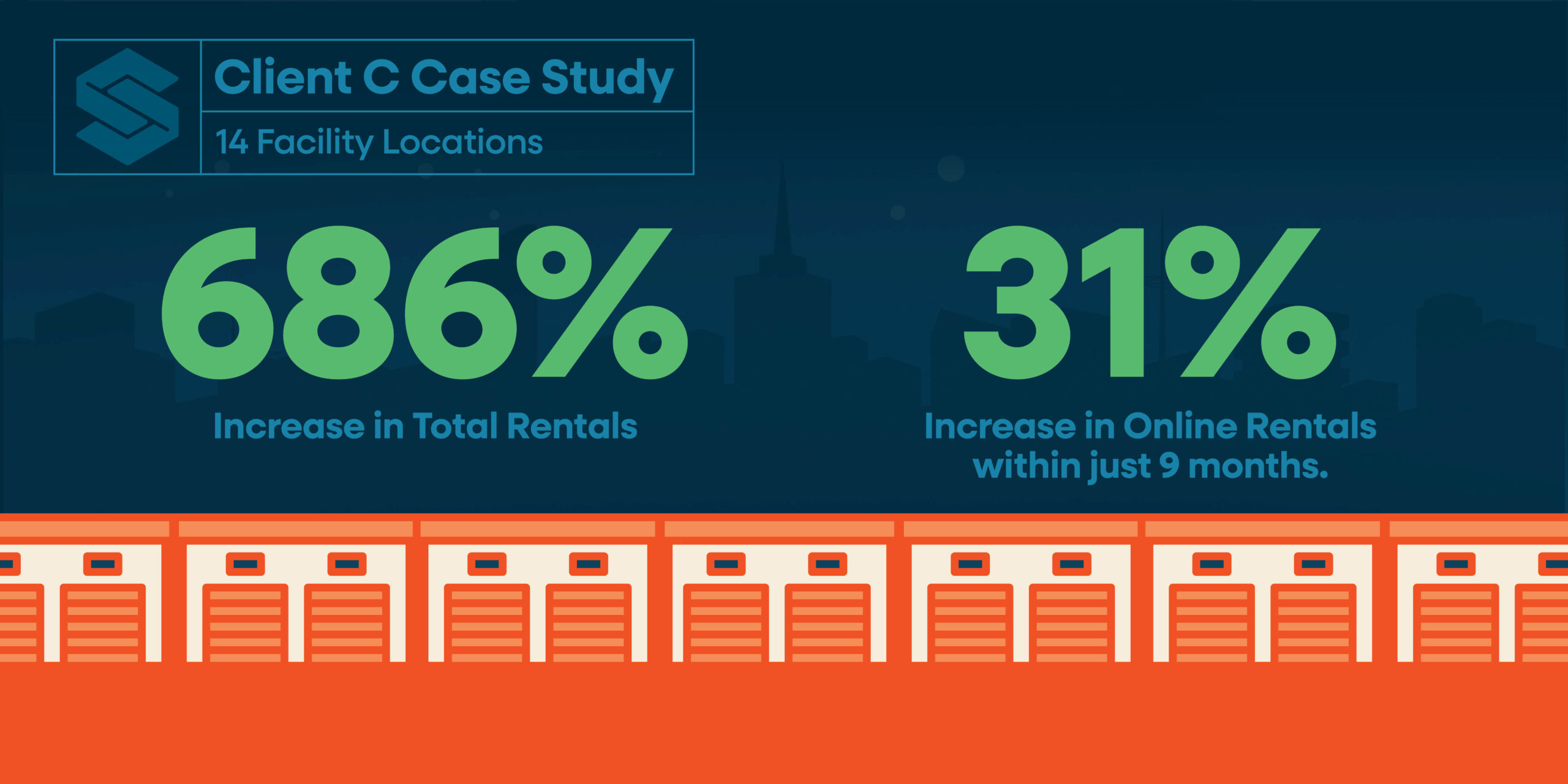
By reducing friction in the checkout process, improving navigation, and incorporating tools like interactive size guides with Calcumate and swivl’s AI-powered chat, Client C made it easier for tenants to complete their rentals with confidence. The result highlights an important takeaway: when the online rental experience is simple, transparent, and efficient, conversions follow.
Innovative Technology Can Help Achieve ROI Goals
The self storage industry is evolving with technological advancements. According to Storable’s 2026 Self Storage Outlook Study,5 operators heading into 2026 are prioritizing customer acquisition, retention, operational efficiency, and smarter pricing, and technology sits at the center of all of it.
Technology is no longer a differentiator by itself; it’s part of your business’s infrastructure. The real question isn’t whether to invest in technology —it’s whether that technology produces measurable results. In short, the industry is shifting from “having a website” to having a digital partner who works 24/7 to increase conversions. An FMS website may offer online rentals, but it may fall short compared to REITs and local competitors that use the latest self storage technology to reduce friction.
Modern renters expect more than static pages and basic size charts. They expect convenient features like:
- Interactive storage calculators
- Real-time unit availability
- Instant AI-powered chat support
- Personalized size recommendations
- Fast, seamless e-signatures and online payments
- Dynamic pricing
Your storage website is the beating heart of your tech stack. A well-designed website equipped with the right integrations and tools is an investment in operational efficiency, higher occupancy, and long-term revenue growth. In a competitive market, the operators who treat their website as an essential investment instead of an afterthought are the ones who stay ahead.
Built-In SEO Increases Traffic for Online Storage Websites
When you’re choosing a storage facility website, it’s imperative to ensure SEO is built into the design for optimum performance. Online storage websites need to be SEO-optimized for both search engines and AI search to improve visibility and traffic. SEO isn’t just about keywords and content (although that’s certainly a part of it). It’s vital for your website to be optimized at a technical level from the ground up.
Your storage website should incorporate the following technical elements for SEO:
Schema Markup
Fast Loading Pages
Mobile-First Web Pages
HTTPS-Secured Pages
Clear site architecture
Location-specific content
Keyword-rich facility pages
A low-cost website won’t deliver value if no one can find it. Visibility drives traffic, and traffic drives rentals.
FAQs: Maximizing Revenue for Online Storage Websites
Are free or included online storage websites worth using for my facility?
While they may seem convenient, free or included websites often act more like digital brochures than revenue-driving tools. They may lack clear navigation, seamless checkout, and conversion-focused design, leading to lost leads and lower occupancy.
How do online storage websites impact tenant conversions?
A high-performing storage website guides renters from search to checkout with minimal friction. Features like flawless navigation, real-time unit availability, interactive size calculators, AI chat support, and mobile-first design increase trust and make it easier for tenants to complete rentals.
Can my storage website improve ROI without aggressive discounts?
Yes. By reducing friction, providing clear pricing, and guiding renters through the process, a storage website can increase conversions without relying solely on price cuts.
How can Storagely help operators maximize revenue with their storage website?
Storagely creates high-converting websites that seamlessly integrate with your FMS, delivering a cohesive, intuitive rental experience. With built-in SEO, real-time unit availability, smart integrations, and a simplified checkout process, the platform is designed to eliminate friction, drive more rentals, and transform your storage website into a true revenue-producing asset.
The Bottom Line
“Free” or “included” websites aren’t inherently bad. They can feel convenient, and they check the “we have a website” box.
Even so, convenience doesn’t always equal performance. If your online presence feels more like a brochure than a cohesive rental engine, it may be costing you more than you think.
In today’s market, your website is your storefront. It’s often the first interaction a prospective tenant has with your brand, and increasingly, it’s where the entire rental decision is made. Your website has the potential to be a true revenue generator, working around the clock to capture leads, convert rentals, and recover abandoned rentals. Unlike that free tote bag, this is one “freebie” you’ll want to evaluate carefully, because, when optimized correctly, it could be your hardest-working employee.
Are you ready to see your self storage website’s full potential? Schedule a demo with Storagely to see how a conversion-first website can help increase revenue and transform your tenant’s digital experience.
References
- Lindgaard, G., Fernandes, G., Dudek, C., & Brown, J. (2011). (PDF) Attention web designers: You have 50 milliseconds to make a good first impression! behaviour and information technology, 25(2), 115-126. Taylor & Francis Online. https://www.researchgate.net/publication/220208334_Attention_web_designers_You_have_50_milliseconds_to_make_a_good_first_impression_Behaviour_and_Information_Technology_252_115-126
- McKeon, K. (2026, February 25). Top 6 website features people value | clutch.co. Clutch. https://clutch.co/resources/top-6-website-features-people-value
- One-second site speed boost can increase conversions … Liquid Web. (2026). https://www.liquidweb.com/white-papers/site-speed-every-second-counts-research-study/
- Statista. (2025, November 19). Global Mobile Traffic 2025. Statista. https://www.statista.com/statistics/277125/share-of-website-traffic-coming-from-mobile-devices/
- Storable. (2025). 2026 Self-Storage Industry Outlook. 2026 Self Storage Outlook Report. https://info.storable.com/2026-self-storage-outlook
- Top 12 Mobile Commerce Statistics of 2025. SellersCommerce. (2025, April 28). https://www.sellerscommerce.com/blog/mobile-commerce-statistics/
Want to read more about storage websites?
- A Closer Look at Mobile-First Self Storage Rentals and Their Impact on ROI
- Why Storagely Has the Best Online Checkout for Self Storage Growth
- What’s Next? The Future of the Best Storage Facility Websites Explained
- The Hidden Friction Points of Online Self Storage Rentals for First-Time Renters
Tagged best self storage websites, online storage websites, Rental system, self storage operators, Self storage rentals, self storage websites, storage facility websites, storage website, Storage Websites, Storagely