Self Storage Marketing: Where Are Your 2026 Move-Ins?
· Storagely · 8 min read · Updated
If you run a self storage facility, 2026 has probably given you reasons to feel confident and reasons to worry. The Self Storage Association’s 2026 Industry Confidence Study says most operators feel the same way, and that has real implications for your self storage marketing.
Here’s what stands out. A survey-record 80% of operators now rank the economy as a top concern. Yet 85% still expect the industry to hold steady or improve, and 83% expect long-term demand to hold or grow. What separates operators this year, the SSA concludes, is execution. And execution is something you can control.
We work with operators every day, and we see the same thing: Renters slip away between the search and the signed lease. This guide shows you where to look.
The gap between forecast and reality
Every time the SSA has run this survey, operators have expected move-ins to outpace move-outs. And every time, their look back showed the opposite: Move-outs ran ahead in 2020, 2024 and again in 2026.
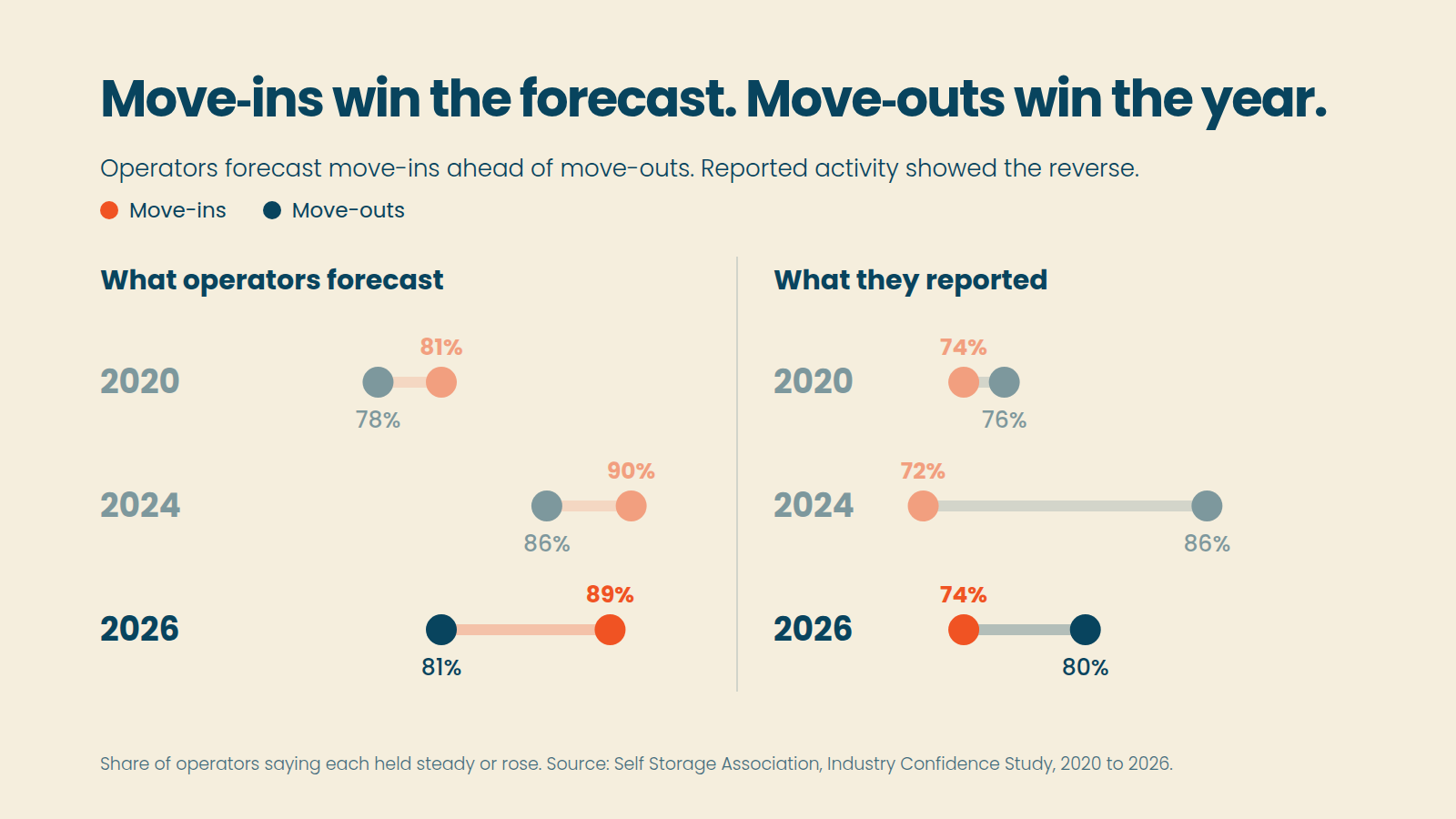
We don’t read that as wishful thinking. Demand is holding. Some renters just aren’t making it to a signed lease. If the problem were demand, all you could do is wait. Conversion is something you can fix, and it’s where your self storage marketing can make up ground fastest.
Why a nervous economy widens the gap
When money is tight, renters don’t stop needing storage. They shop harder. They open three tabs, compare prices, read the reviews and leave the first site that makes them work for it. The SSA flags the same squeeze from the operator side: Rising costs on one end, more hesitant spenders on the other. That worry has grown fast. Economic concern jumped nearly 20 points since 2024, the biggest jump of any concern the SSA has tracked.
That changes the math on your self storage marketing. In a nervous year, a clunky rental flow hands renters to whoever’s next in the search results. Renters don’t land on your site for free. Ad clicks, listing fees, website costs and the time you spend on reviews all add up.
Five places to win back forecast move-ins
These are the five spots where self storage marketing most often loses renters between search and signature.
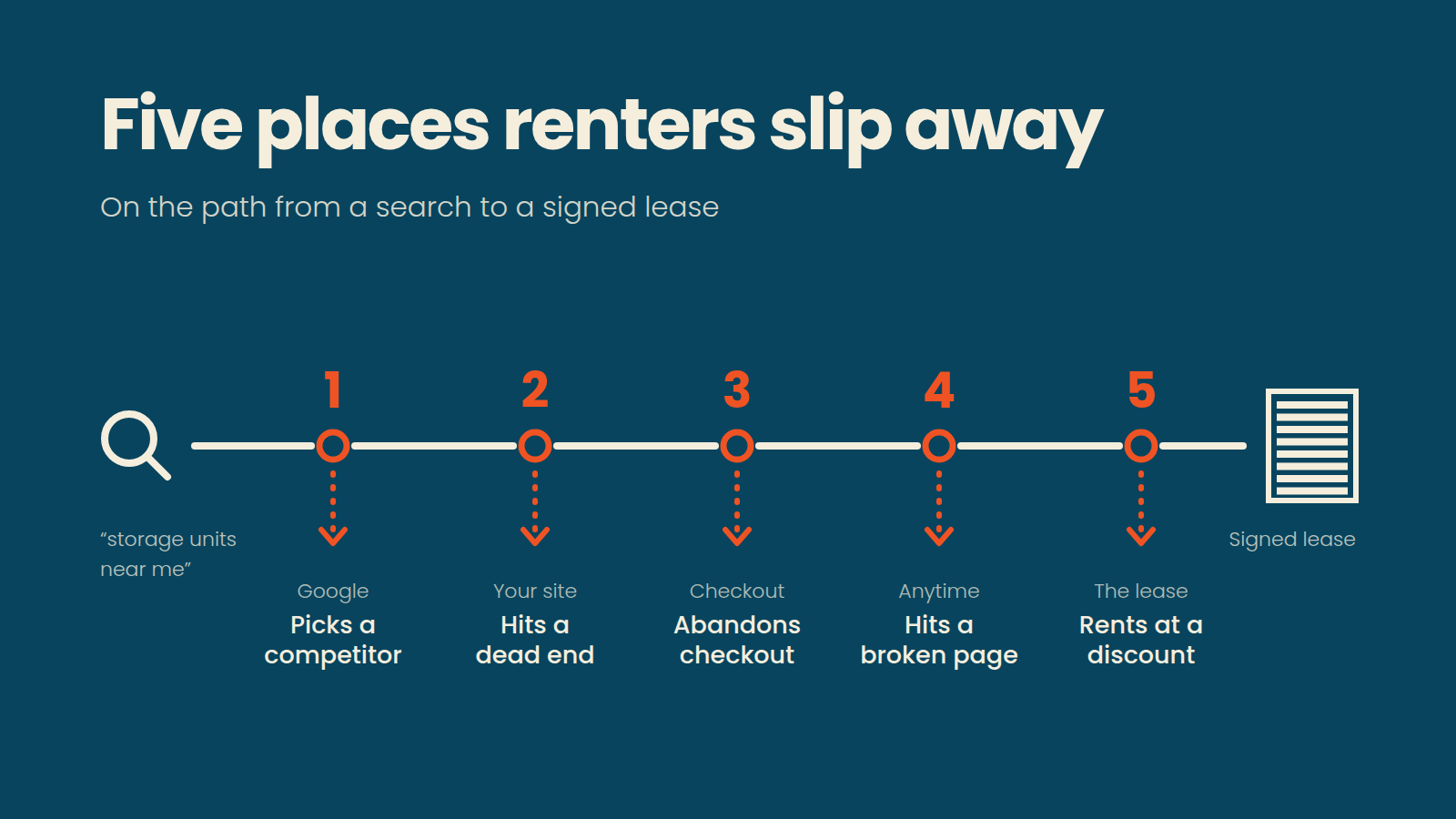
1. They find you, but pick someone else
A renter’s first impression usually isn’t your website. It’s your Google listing, your star rating and how recent your reviews are.
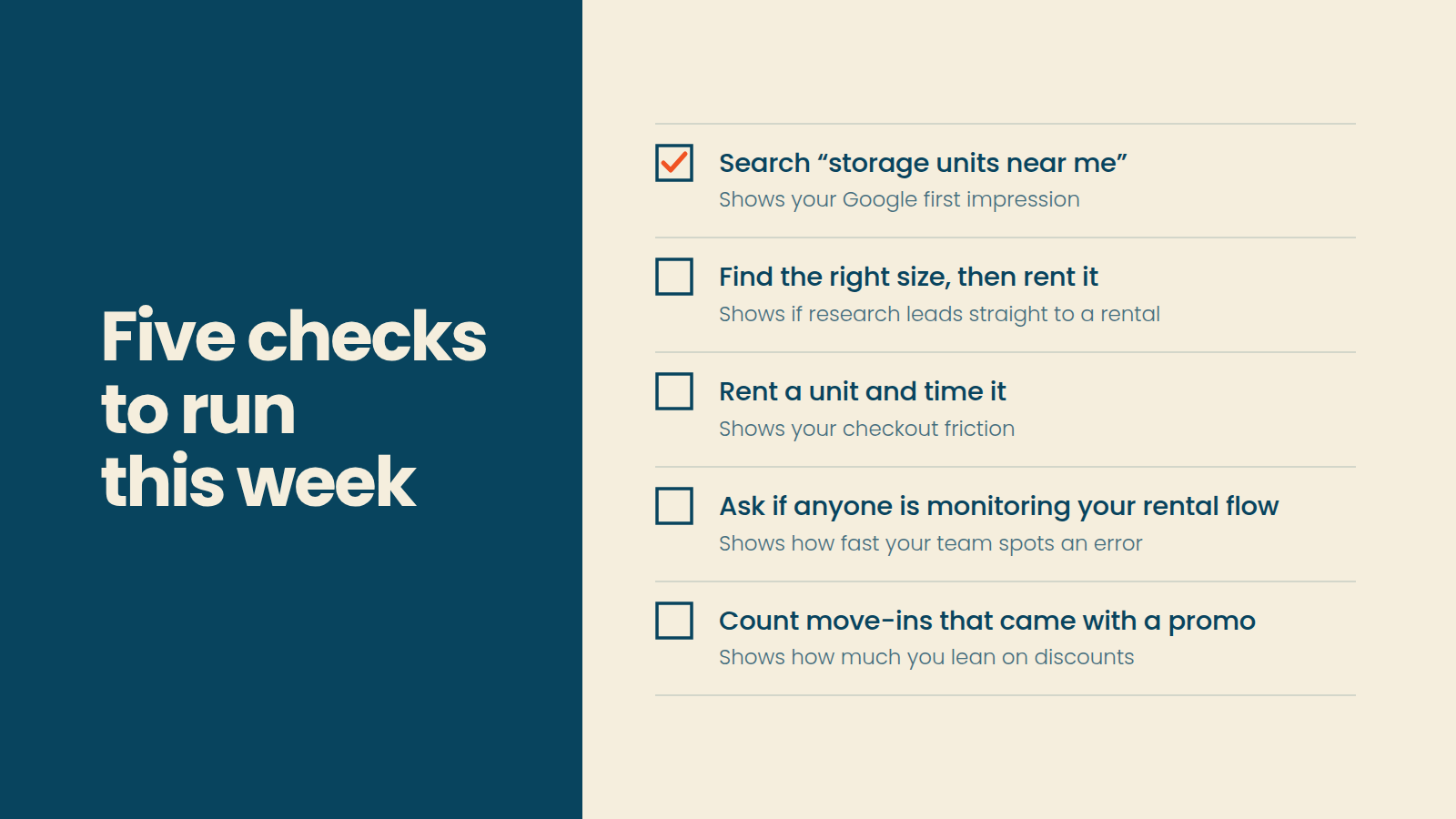
Check it this week: Search “storage near me” from your own parking lot. Compare your review count and latest review date with the three closest facilities.
How Storagely helps: Atlas pulls each location’s details from its Google Business Profile, so your site and listing never disagree. Automated review requests keep fresh reviews coming in.
2. They do their research, then hit a dead end
A good test of your website’s effectiveness is whether renters can research and rent in one place. If your size guide sends them back to hunt for that 10x10 again, that’s a dead end. And if research is hard, they’ll do it on a competitor’s site and may rent there instead.
Check it this week: Use your size guide to find the right unit, then count the steps to start renting it from that spot.
How Storagely helps: Storagely builds in multiple conversion points, so the size guide, interactive facility map and unit select all lead straight into checkout. And because Storagely connects with the facility management software you already run, including Storable EDGE, SiteLink, Self Storage Manager, QuikStor, Monument and Cubby, the units and rates renters see are always current.
3. They start renting, but don’t finish
Every extra field and every extra page is a chance to stall, especially on a phone.
Check it this week: Rent a unit on your own site, on your phone, and time it. Count the fields and pages. Then try a competitor’s.
How Storagely helps: Buying a car shouldn’t be easier than renting a unit. With Storagely, renters can complete a rental in 60 seconds or less. And since most of your traffic likely comes from phones, our checkout is built mobile first, with larger, app-like steps sized for thumbs. On desktop, unit selection, pricing and rental all sit on one page.
4. Something breaks, and nobody notices
A broken “Rent Now” button at 11pm never shows up in your occupancy report. It shows up as move-ins that don’t happen. Many operators assume that if the site is up, it’s working. But those types of checks can’t tell you whether a renter can pick a unit, enter their details and pay properly.
Check it this week: Ask if anyone is monitoring your rental flow.
How Storagely helps: Pulse, Storagely’s 24/7 site monitoring, tests every link, page and click in the renter’s journey, so you catch a broken rental flow before your renters do.
5. They rent, but at a discount you didn’t need to give
When move-ins lag, a free month is the easiest lever to pull. The SSA’s advice is to protect pricing discipline rather than trade it for short-term occupancy. The trend is already moving that way: 65% of operators expect discounting to hold steady or decline, up from 60% in 2020 and 62% in 2024.
Check it this week: Look at how many of last month’s move-ins came with a promo, and whether the ones that didn’t stayed just as long.
How Storagely helps: A discount is the easy way to win a renter. Showing value is the better one. Visual size guides help renters picture what fits, unit maps let them choose the exact space they want, and value-based pricing ties each rate to the features behind it. Service and merch upsells at checkout then add to the rental, so a free month isn’t the only thing doing the selling.
Don’t forget the other half of occupancy
Winning the renter is only half the job. Move-outs outran move-ins in every survey, and the SSA’s top advice for 2026 is to guard collections and tenant screening before the economy softens further.
What happens at and after the rental plays a part too. Autopay at checkout, accurate tenant details and protection plans all set renters up to stay longer and pay on time.
But the renters most likely to stay are the ones who got exactly what they expected. That makes retention a marketing question too: How accurate is your brand marketing? If what renters saw online matches what they find at your location, they start out satisfied. If not, they can develop distrust and buyer’s remorse.
Where to start, by portfolio size
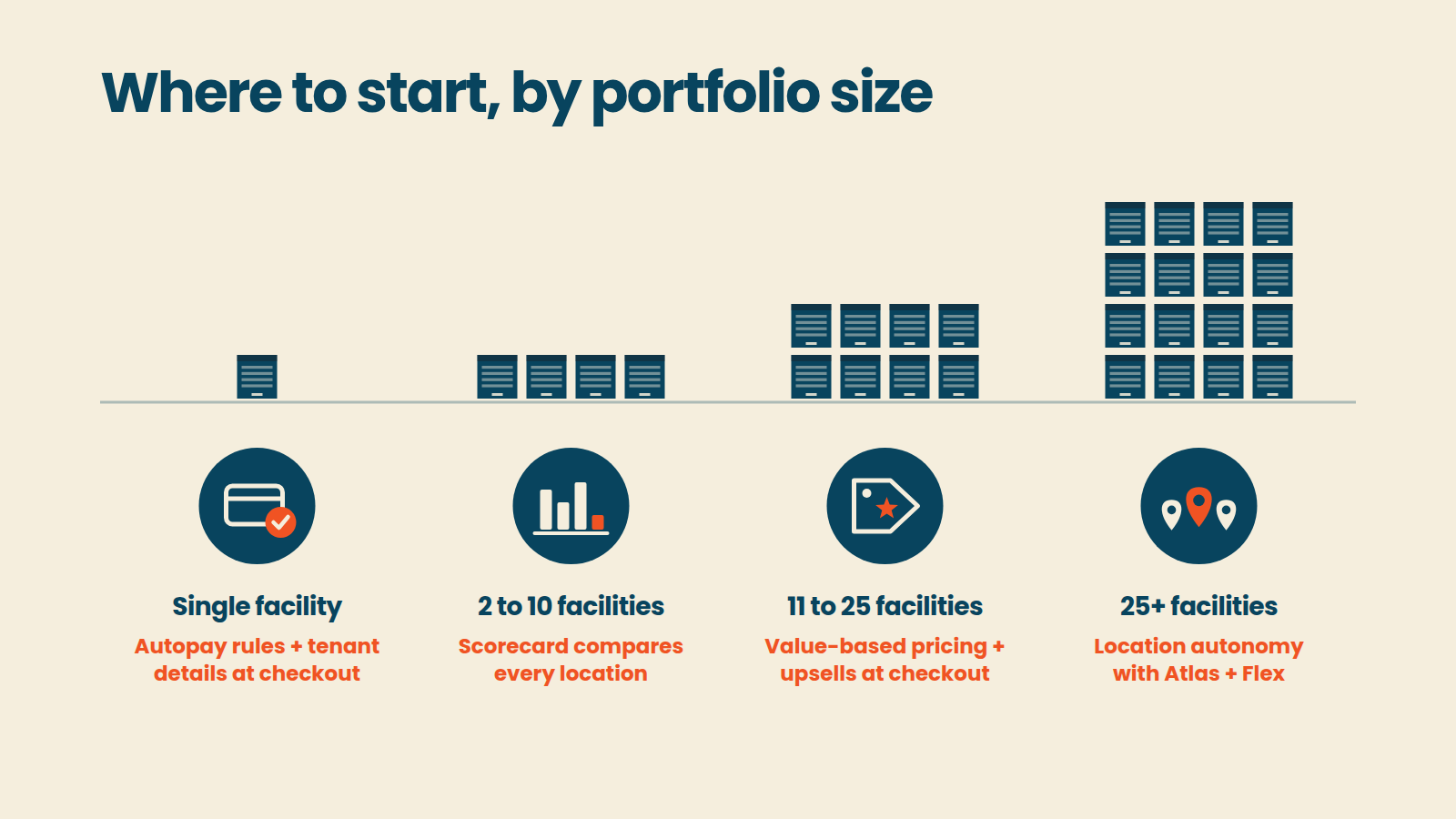
The SSA broke its results out by portfolio size, and each group is under a different kind of pressure. No website fixes the economy or new supply. But each finding points to something you can control, and that’s where we’d start.
Portfolio | What the SSA found | What you can control | Where to start in Storagely |
|---|---|---|---|
Single facility | More single-facility owners saw late payments get worse than any other group. | Who rents and how they pay. Collections problems often start at the rental. | Autopay rules and extra tenant details collected at checkout. |
2 to 10 facilities | The group least likely to expect storage demand to grow. | Capturing more existing demand and spotting which location loses renters. | Scorecard compares traffic, rankings, reviews and rentals by location. |
11 to 25 facilities | The strongest move-ins, but the weakest pricing discipline and most move-outs. | Whether growth comes from promos or from value. | Value-based pricing and upsells at checkout grow revenue per rental without leaning on discounts. |
25+ facilities | The most confident group, yet economic concern roughly doubled since 2024. | How fast every site can react when conditions shift. | With full location autonomy and Atlas + Flex custom editing capabilities, any location can quickly pivot to stand out in their own markets. |
Where you operate matters too
The Southeast leads on confidence and delinquency but worries most about oversupply. The Southwest faces the most pressure, with the highest economic concern and the weakest delinquency numbers as it absorbs new construction. The Northeast shows the strongest occupancy signal. The SSA’s advice: Don’t run on a single national playbook.
If you operate in multiple regions, one size may not fit all. Atlas and Flex give you more room to customize each location and build brand recognition, so your facilities stand out against local competition as each market ebbs and flows.
Close the gap in 2026
Only you can see how many renters your self storage marketing loses between the search bar and the signed lease.
Whether you run one facility or fifty, we built Storagely to help turn more of the renters who find you into renters who move in. Make 2026 the year your self storage marketing gets measured in rentals, not just traffic.
Want a second set of eyes on your self storage marketing? We’d love to help. See how Storagely turns renter intent into rentals.
Sources
Self Storage Association, 2026 Industry Confidence Study: Cautious Optimism in a More Uncertain Economy. Survey of 500 U.S. self storage operators and owners, fielded May 20-27, 2026, with comparison waves in 2020 (n=402) and 2024 (n=401). Figures reflect operator perception, not direct tenant behavior. Full research available at selfstorage.org under Research & Data.